The Business Times: What Western Headlines Miss About SE Asian Private Credit
Spotlighting regional credit resilience: Randy Sim breaks down Southeast Asia’s market advantage in The Business Times.
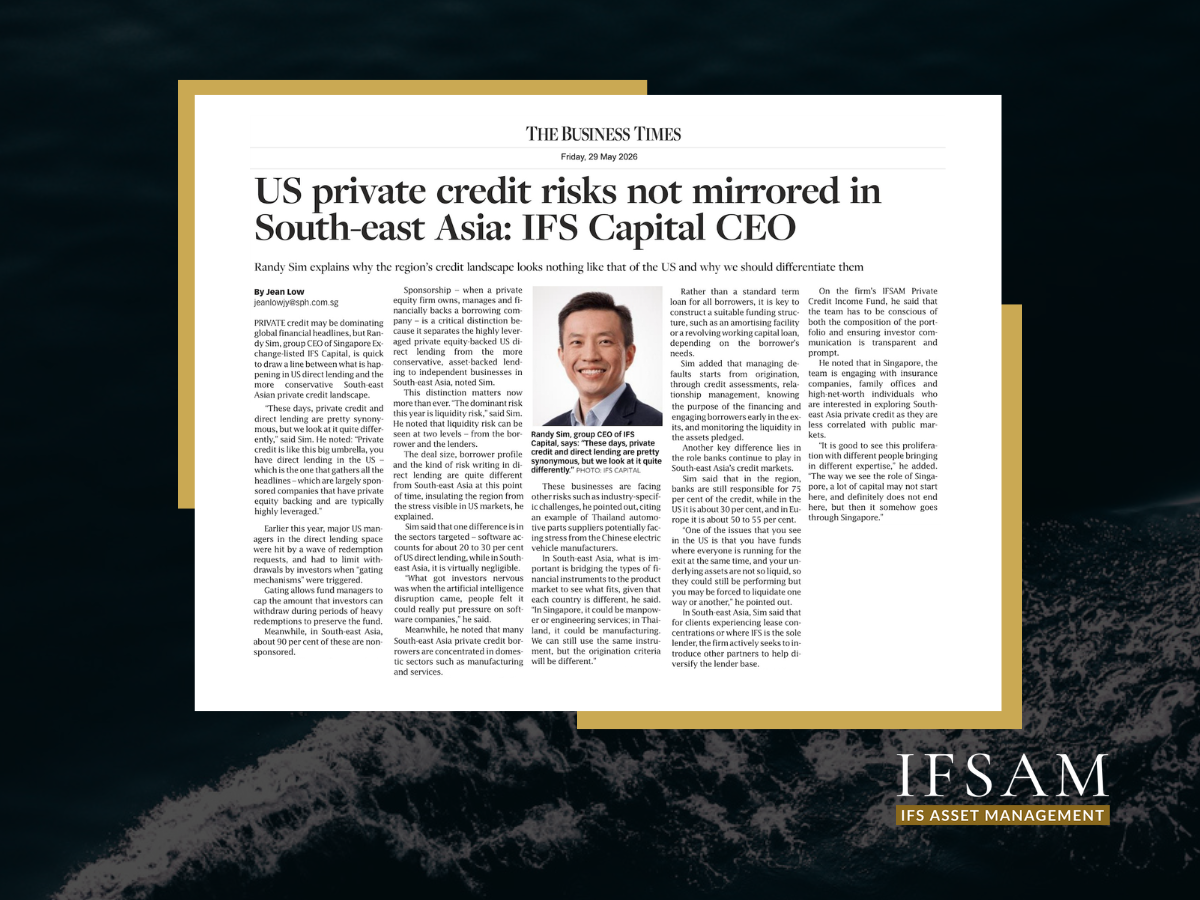


Earlier this year, there were headlines on redemption waves that affected major US managers in the direct lending space. It is important to highlight the difference where software accounts for 20-30% of US direct lending whereas it is virtually negligible in Southeast Asia.
Further in Southeast Asia, deal size, borrower profile and underwriting risks differ from that in the US markets. While gating is a standard structural tool used to manage liquidity mismatches in private credit funds, it understandably prompts investor caution.
The Divergence: US vs. Southeast Asian Private Credit
As noted by IFS Capital Limited Group CEO, Randy Sim in a recent interview with The Business Times, the structural risks within private credit vary significantly across regions along with its underlying exposure to the various market segments.
"𝘛𝘩𝘦𝘴𝘦 𝘥𝘢𝘺𝘴, 𝘱𝘳𝘪𝘷𝘢𝘵𝘦 𝘤𝘳𝘦𝘥𝘪𝘵 𝘢𝘯𝘥 𝘥𝘪𝘳𝘦𝘤𝘵 𝘭𝘦𝘯𝘥𝘪𝘯𝘨 𝘢𝘳𝘦 𝘱𝘳𝘦𝘵𝘵𝘺 𝘴𝘺𝘯𝘰𝘯𝘺𝘮𝘰𝘶𝘴, 𝘣𝘶𝘵 𝘸𝘦 𝘭𝘰𝘰𝘬 𝘢𝘵 𝘪𝘵 𝘲𝘶𝘪𝘵𝘦 𝘥𝘪𝘧𝘧𝘦𝘳𝘦𝘯𝘵𝘭𝘺,” said Sim. He noted: “𝘗𝘳𝘪𝘷𝘢𝘵𝘦 𝘤𝘳𝘦𝘥𝘪𝘵 𝘪𝘴 𝘭𝘪𝘬𝘦 𝘵𝘩𝘪𝘴 𝘣𝘪𝘨 𝘶𝘮𝘣𝘳𝘦𝘭𝘭𝘢, 𝘺𝘰𝘶 𝘩𝘢𝘷𝘦 𝘥𝘪𝘳𝘦𝘤𝘵 𝘭𝘦𝘯𝘥𝘪𝘯𝘨 𝘪𝘯 𝘵𝘩𝘦 𝘜𝘚, 𝘸𝘩𝘪𝘤𝘩 𝘪𝘴 𝘵𝘩𝘦 𝘰𝘯𝘦 𝘵𝘩𝘢𝘵 𝘨𝘢𝘵𝘩𝘦𝘳𝘴 𝘢𝘭𝘭 𝘵𝘩𝘦 𝘩𝘦𝘢𝘥𝘭𝘪𝘯𝘦𝘴, 𝘸𝘩𝘪𝘤𝘩 𝘢𝘳𝘦 𝘭𝘢𝘳𝘨𝘦𝘭𝘺 𝘴𝘱𝘰𝘯𝘴𝘰𝘳𝘦𝘥 𝘤𝘰𝘮𝘱𝘢𝘯𝘪𝘦𝘴 𝘵𝘩𝘢𝘵 𝘩𝘢𝘷𝘦 𝘱𝘳𝘪𝘷𝘢𝘵𝘦 𝘦𝘲𝘶𝘪𝘵𝘺 𝘣𝘢𝘤𝘬𝘪𝘯𝘨 𝘢𝘯𝘥 𝘢𝘳𝘦 𝘵𝘺𝘱𝘪𝘤𝘢𝘭𝘭𝘺 𝘩𝘪𝘨𝘩𝘭𝘺 𝘭𝘦𝘷𝘦𝘳𝘢𝘨𝘦𝘥."
In contrast, the Southeast Asian private credit landscape is predominantly non-sponsored, at about 90% of all transactions. While non-sponsored transactions operate without the secondary equity backing common in Western corporate structures, they are typically characterised by different baseline leverage profiles and direct exposure to the borrower's operating and/or real assets.
IFSAM’s Approach to Risk and Transparency
The approach taken by IFS Asset Management (IFSAM) Private Credit Income Fund (the “Fund”) focuses on two core operational principles:
1. 𝐀𝐬𝐬𝐞𝐭-𝐁𝐚𝐜𝐤𝐞𝐝 𝐏𝐨𝐫𝐭𝐟𝐨𝐥𝐢𝐨 𝐂𝐨𝐦𝐩𝐨𝐬𝐢𝐭𝐢𝐨𝐧: Focusing on conservative, asset-backed lending collateralised by real estate, the Fund seeks to manage risks, deliberately avoiding highly leveraged or overly complex corporate debt structures.
2. 𝐏𝐫𝐨𝐚𝐜𝐭𝐢𝐯𝐞 𝐓𝐫𝐚𝐧𝐬𝐩𝐚𝐫𝐞𝐧𝐜𝐲 𝐌𝐚𝐧𝐚𝐠𝐞𝐦𝐞𝐧𝐭: Prioritising our investors, IFSAM adopts regular monitoring and provides prompt and transparent updates to our investors. We provide regular portfolio breakdown and valuation metrics which has demonstrated the strength of our portfolios.
Given that private credit market is less correlated to the public markets, we believe it has a place in strategic asset allocation. Its relative stability could draw interests from investors such as insurance companies, family offices, and high-net-worth individuals) to explore Southeast Asian private credit.
Further Reading: to learn more about conversation on regional private credit landscape between Randy and The Business Times, visit this link here.